What Causes Lung Cancer In A Non Smoker - Even Non Smokers Can Get Lung Cancer University Of Utah Health / In the past five to 10 years, new knowledge about lung cancer has changed the way it is treated in both smokers and nonsmokers.. Tobacco smoke is a toxic mix of more than 7,000 chemicals. This fault is commonly found in asian women who had never smoked and developed lung cancer. Workplace exposure to asbestos and other substances known to cause cancer — such as arsenic, chromium and nickel — can increase your risk of developing lung cancer, especially if you're a smoker. Just living with a smoker increases your chance of developing lung cancer or heart. Squamous cell carcinoma of the lungs
Causes and risk factors the primary cause of lung cancer among people who have never smoked is radon, according to the environmental protection agency (epa). Age, secondhand smoke, cooking fumes, radon, environmental exposures, genetic factors, underlying lung disease, oncogenic viruses, and estrogens. If you breathe in radon over long periods of time, you may end up with lung cancer. Sidestream smoke (the more toxic of the two) is. People with a parent, sibling or child with lung cancer have an increased risk of the disease.
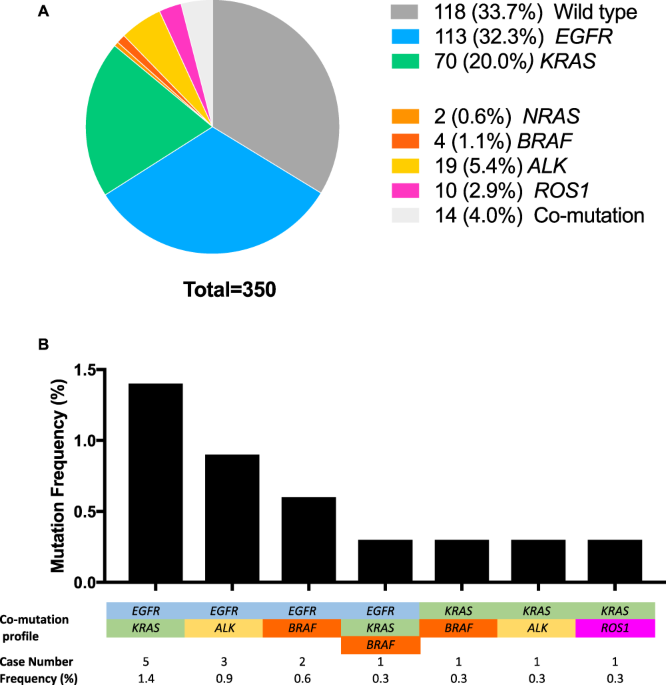
Actionable Mutation Profiles Of Non Small Cell Lung Cancer Patients From Vietnamese Population Scientific Reports from media.springernature.com (nonsmoking men are, too, but to a lesser extent.) toxins in the environment, genetic predisposition and interactions with hormones may hold clues to why this is occurring. In the united states, cigarette smoking is linked to about 80% to 90% of lung cancer deaths. Lung cancer occurrence in never smokers. Lung cancer can be caused by many risk factors other than smoking cigarettes. Although radon occurs naturally in an outdoor environment, concentrated levels of the gas. Workplace exposures to asbestos, diesel exhaust or certain other chemicals can also cause lung cancers in some people who don't smoke. Cigarette smoking is the number one risk factor for lung cancer. Radon is responsible for about 21,000 lung cancer deaths every year.
In the past five to 10 years, new knowledge about lung cancer has changed the way it is treated in both smokers and nonsmokers.
A small portion of lung cancers occur in people with no known risk factors for the disease. Although radon occurs naturally in an outdoor environment, concentrated levels of the gas. Multiple studies have confirmed that smoking is by far the leading cause, as close to 90 percent of all lung cancers stem from tobacco use. Lung adenocarcinomas tend to grow in the outer regions of the lungs. Sidestream smoke (the more toxic of the two) is. While it's true that 90 percent of lung cancer cases are smoking related, 10 percent come from other causes, and that number is even higher in utah at 30 percent. Due to their location away from the large airways, these tumors often grow quite large or spread before they cause any symptoms. Overall, radon is the second leading cause of lung cancer. Age, secondhand smoke, cooking fumes, radon, environmental exposures, genetic factors, underlying lung disease, oncogenic viruses, and estrogens. Causes and risk factors the primary cause of lung cancer among people who have never smoked is radon, according to the environmental protection agency (epa). This fault is commonly found in asian women who had never smoked and developed lung cancer. Using other tobacco products such as cigars or pipes also increases the risk for lung cancer. In the past five to 10 years, new knowledge about lung cancer has changed the way it is treated in both smokers and nonsmokers.
Lung adenocarcinomas tend to grow in the outer regions of the lungs. Different genes are changed, or mutated, in each. Passive smoking, or the inhalation of tobacco smoke from other smokers sharing living or working quarters, is an established risk factor for the development of lung cancer. Radon is responsible for about 21,000 lung cancer deaths every year. Overall, radon is the second leading cause of lung cancer.
Lung Cancer Sydney Freedman And Rachel Rea Causes No Exact Cause Smokers And Non Smokers Can Get Lung Cancer Smoke Causes Cancer By Damaging Ppt Download from images.slideplayer.com A small portion of lung cancers occur in people with no known risk factors for the disease. Family history of lung cancer. While there are multiple causes of lung cancer in nonsmokers, secondhand smoke and radon account for over 25 percent of these cases. Just living with a smoker increases your chance of developing lung cancer or heart. These risk factors include exposure to other people's smoke (called secondhand smoke), radon, air pollution, a family history of lung cancer, and asbestos. While it's true that 90 percent of lung cancer cases are smoking related, 10 percent come from other causes, and that number is even higher in utah at 30 percent. Although radon occurs naturally in an outdoor environment, concentrated levels of the gas. Lung cancer can be caused by many risk factors other than smoking cigarettes.
Just living with a smoker increases your chance of developing lung cancer or heart.
If you breathe in radon over long periods of time, you may end up with lung cancer. Just living with a smoker increases your chance of developing lung cancer or heart. Causes and risk factors the primary cause of lung cancer among people who have never smoked is radon, according to the environmental protection agency (epa). The stigma associated with lung cancer is that it's a smokers' disease and they've brought it on themselves. Family history of lung cancer. Passive smoking, or the inhalation of tobacco smoke from other smokers sharing living or working quarters, is an established risk factor for the development of lung cancer. Workplace exposure to asbestos and other substances known to cause cancer — such as arsenic, chromium and nickel — can increase your risk of developing lung cancer, especially if you're a smoker. Due to their location away from the large airways, these tumors often grow quite large or spread before they cause any symptoms. Breathing it in may increase a person's risk of lung cancer. Cigarette smoking is the number one risk factor for lung cancer. Workplace exposures to asbestos, diesel exhaust or certain other chemicals can also cause lung cancers in some people who don't smoke. Multiple studies have confirmed that smoking is by far the leading cause, as close to 90 percent of all lung cancers stem from tobacco use. Lung cancer can be caused by many risk factors other than smoking cigarettes.
Overall, radon is the second leading cause of lung cancer. Workplace exposures to asbestos, diesel exhaust or certain other chemicals can also cause lung cancers in some people who don't smoke. In the united states, cigarette smoking is linked to about 80% to 90% of lung cancer deaths. Sidestream smoke (the more toxic of the two) is. These risk factors include exposure to other people's smoke (called secondhand smoke), radon, air pollution, a family history of lung cancer, and asbestos.
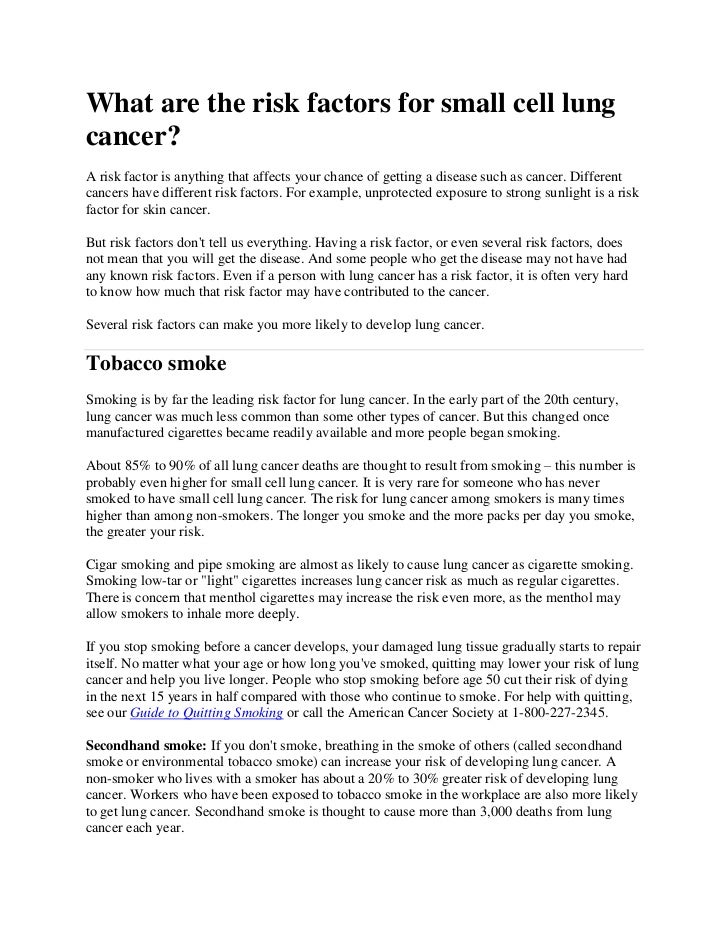
What Are The Risk Factors For Small Cell Lung Cancer from image.slidesharecdn.com Causes and risk factors the primary cause of lung cancer among people who have never smoked is radon, according to the environmental protection agency (epa). Passive smoking, or the inhalation of tobacco smoke from other smokers sharing living or working quarters, is an established risk factor for the development of lung cancer. Cause of lung cancer #1: Cigarette smoking is the number one risk factor for lung cancer. The latter group is more likely to develop lung cancer as a result of a genetic mutation or abnormality. Multiple studies have confirmed that smoking is by far the leading cause, as close to 90 percent of all lung cancers stem from tobacco use. Lung cancer can be caused by many risk factors other than smoking cigarettes. These risk factors include exposure to other people's smoke (called secondhand smoke), radon, air pollution, a family history of lung cancer, and asbestos.
In the past five to 10 years, new knowledge about lung cancer has changed the way it is treated in both smokers and nonsmokers.
Shamus carr at huntsman cancer institute, including. Lung cancer can be caused by many risk factors other than smoking cigarettes. Different genes are changed, or mutated, in each. About 2,900 of these deaths occur among people who have never smoked. Although radon occurs naturally in an outdoor environment, concentrated levels of the gas. These risk factors include exposure to other people's smoke (called secondhand smoke), radon, air pollution, a family history of lung cancer, and asbestos. Cause of lung cancer #1: Multiple studies have confirmed that smoking is by far the leading cause, as close to 90 percent of all lung cancers stem from tobacco use. (nonsmoking men are, too, but to a lesser extent.) toxins in the environment, genetic predisposition and interactions with hormones may hold clues to why this is occurring. Secondhand smoke includes smoke exhaled by a smoker and smoke emitted from the lit end of a cigarette, pipe, or cigar, or from tobacco burning in a hookah. There are two different types. That's because it breaks down into tiny particles that can get into your lungs and damage cells there. While there are multiple causes of lung cancer in nonsmokers, secondhand smoke and radon account for over 25 percent of these cases.